Organ Studio
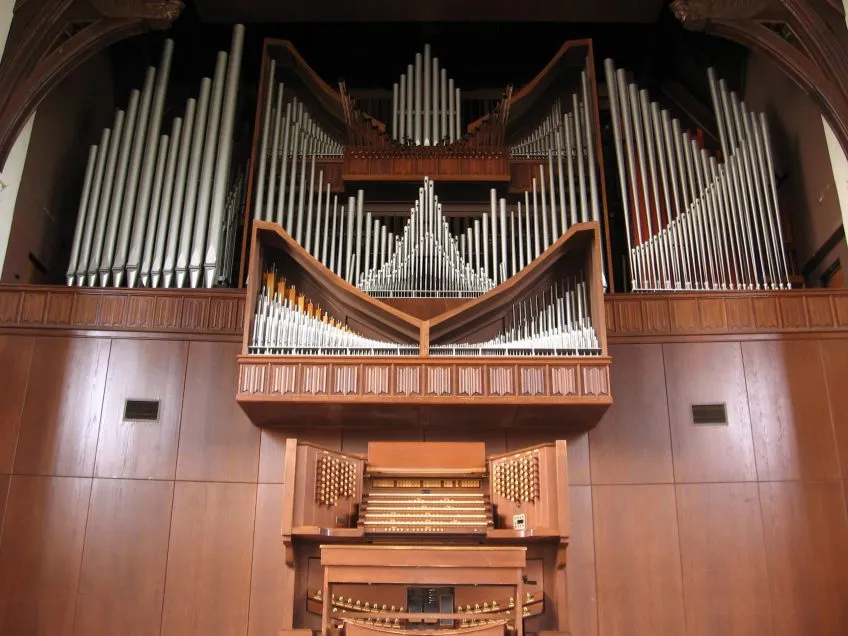
From celeste to en chamade, glorious organ music may often be heard in the University Auditorium. We have a busy year planned, so please check out our events where you can hear UF organists and guests perform! Keep track of the latest studio news by following us on Facebook!
Want to know more about the Andrew Anderson Memorial Organ at UF? The studio prepared a virtual organ demonstration in Fall 2020 — learn more about our fabulous instrument. This historic organ turns 100 in 2025! Check out our UF Pipe Organ Centennial website for more information.
What is a “Halloween Spooktacular?” Check out the organ studio’s 2020 presentation!
Meet the UF Organists
The University Auditorium Organ
A financial gift by Dr. Andrew Anderson, a St. Augustine physician, philanthropist, and associate of early Florida developer Henry Flagler, provided the funds for a pipe organ in the newly constructed University Auditorium. Tonal plans were prepared by William Zeuch of Boston’s famous Skinner Organ Company, which built and installed the instrument in early 1925. The organ was first played publicly on June 7, 1925, at the annual University Commencement Convocation. A musical landmark for its day, the organ was designed and voiced at the zenith of orchestral-imitative or “symphonic” organ design in this country, and is mentioned in such reference works as Orpha Ochse’s The History of the Organ in the United States and Charles Callahan’s The American Classic Organ. Claude Murphree, university organist from 1925-1958, performed over 550 concerts on this instrument and his Sunday afternoon recitals became a tradition on campus.
During World War II and immediately after, due to institutional economic conditions, the instrument itself was not given proper care. This University treasure was virtually buried behind layers of heavy velour curtains hung in front of the organ to allow theatrical presentations. When the Division of Music was established in 1948, however, immediate efforts were made to rescue the instrument.
Willis Bodine succeeded Murphree as university organist in 1959 and by the early 1960’s the curtains were removed. Under Bodine’s leadership, the Aeolian-Skinner Organ Company began a program of mechanical renovation and tonal rehabilitation to repair the damage caused by the ravages of time and neglected maintenance. By 1976, renovation and air-conditioning of the building had been completed, but Aeolian-Skinner was no longer in business. In 1992 the M. P. Möller Organ Company continued the careful work of restoring the organ to its former excellence as a teaching and recital instrument.
Laura Ellis joined the UF faculty in 2003 to become the third university organist in the history of the institution. In the fall of 2014, the Reuter Organ Company located in Lawrence, KS, was contracted to provide tonal renovations to the instrument. Twenty-four new ranks of principal pipes were built to revise and enhance the Great, Swell, Positiv and Choir choruses. Reed pipes in all divisions were rebuilt or replaced. Other stops were rescaled and wind pressures were adjusted. Finally, the entire instrument was re-voiced to achieve a new tonal balance, characterized by abundant fundamental tone and greater clarity. The newly renovated organ was heard for the first time during the Phantom of the Opera, presented by the College of the Arts in January 2015. Click here for the specifications.

Facts about the Andrew Anderson Memorial Organ:
- “Music for the Testaments Old and New”, a 2-CD set recorded by Dr. Ellis on the Andrew Anderson Memorial Organ, was released in January 2017.
- Notable organists to have performed on the UA organ include Marcel Dupré, E. Power Biggs, Virgil Fox, Catharine Crozier, and Dame Gillian Weir.
- Willis Bodine served as UF’s University Organist from 1959-2003.
Practice Organs
Kinzey/Bodine
Tonal Design: Willis Bodine, Jr.
Organ Builder: Bertram Kinzey, Jr.
Gainesville, FL, 1972
The history of this organ dates back to 1970 with a research project on the Acoustical Influences of Casework Enclosing Pipe Organs. Bertram Kinzey, Professor in the College of Architecture, headed this study. The music building was recently constructed and, thus, in need of a few practice organs. This study would not only supply the researchers with an instrument to examine, but the School of Music would receive the organ as a practice instrument. The tonal design was formulated by then University Organist and Professor Emeritus Willis Bodine (UF faculty member from 1959-2003). The instrument consists of 8 ranks and has electric and stop action.
Stop List
Grand Orgue
16′ Basse Conique
8′ Bourdon A’Cheminee
8′ Flute Conique
4′ Prestant
4′ Flute
2′ Doublette
IV Fourniture
V Cornet
8′ Trompette
Recit
8′ Bourdon
8′ Flute Conique
4′ Flute Traversiere
4′ Douce
2-2/3′ Nasard
2′ Quarte de Nasard
1-3/5′ Tierce
8′ Trompette
4′ Clarion
Positiv
8′ Bourdon A’Cheminee
4′ Flute A’Fuseau
4′ Douce
2′ Octavin
1-1/3′ Larigot
1′ Sifflet
II Cymbale
4′ Clarion
Pedal
16′ Bourdon Basse
8′ Montre
8′ Bourdon
8′ Flute Conique
4′ Prestant
2′ Flute A’Bec
V Fourniture
8′ Trompette
4′ Clarion
2′ Dessus de Trompette
No couplers
Manual compass: 61 notes
Pedal compass: 32 notes
Kinzey-Angerstein
This organ has two manuals with 6 stops over 5 ranks. The instrument has slider chests and mechanical key action.
Opus 1, 1974
Stop List
Manual I
8′ Spillflote
4′ Principal
Manual II
8′ Gedackt
2′ Waldflote
Pedal
16′ Subbass
8′ Pommer
No couplers
Manual Compass: 56 notes
Pedal Compass: 30 notes
Klug & Schumacher
Opus 6, 1980
The history of this organ is a colorful one. In the late 1930s, Claude Murphree, the first University Organist, felt the need for a small practice organ to supplement the large Auditorium instrument. A four-rank Kimball unit organ, entirely self-contained, was purchased and installed in the Florida Union Auditorium.
In 1960, it was realized that the needs of the Department of Music for organ practice space could not be met if the instrument remained in a location also used for committee meetings, movies, etc. The organ was, therefore, moved to Building “R” during the Thanksgiving holidays and set up in practice room 136. In 1966, the organ was completely overhauled and rebuilt by John Harold Murphy Pipe Organs of St. Petersburg, FL, a subsidiary of the Reuter Organ Company.
The Kimball/Murphy organ was completely changed and renovated again in 1980 by Klug & Schumacher, Inc. The company converted the organ into a fully functional tracker instrument. Certain parts of the organ (e.g. casework, blower, parts of the console, certain pipes, etc.) would be used in the new organ by Klug & Schumacher. The finished and current organ was installed in June of 1980.
Stop List
Manual I
8′ Spillflote
4′ Principal
Manual II
8′ Spitzprincipal
2′ Spitzflote
Pedal
16′ Subbass
8′ Gedeckt
Couplers
Manual II to Manual I
Manual I to Pedal
Manual II to Pedal
Manual Compass: 56 notes
Pedal Compass: 30 notes
Historic Instruments
The University of Florida School of Music maintains a number of historic instruments that are available for student use:
Herz Double Harpsichord
Built for the University of Florida by Eric Herz, Boston, in 1967, this concert harpsichord is in the eighteenth-century English/German style. The double manual instrument has pedal register action and a compass of FF-g3. Manual I has three sets of strings: 16′, 8′, and 4′; Manual II has two 8′ sets of strings. The instrument has lute, buff, and inter-manual coupler.
Kingston Single Harpsichords
The School of Music has two Kingston Single Harpsichords:
UF’s second Kingston single harpsichord is a bequest from the estate of Jeffrey Wyke (BM ’82; MFA ’84). While a student at UF, Mr. Wyke was impressed by the aforementioned Kingston harpsichord housed in the School of Music. After graduating, Jeffrey commissioned the renowned builder Richard Kingston to build a new instrument.
Often rented by area music ensembles, the School of Music’s Kingston single harpsichord was built for the University of Florida by Richard Kingston, Marshall, NC, in 1980. In the 17th-century Flemish style, the instrument has a compass of BB-d3, two 8′ sets of strings, buffs, and a transposing keyboard.
Neupert Double Harpsichord
Recently restored, this harpsichord was built by J.C. Neupert. The instrument was purchased for the Division of Music in the 1950s by Pat Beecher. The instrument has leather plectra, pedal stop controls, and a 16’-8’-8’-4’ disposition.
Hubbard French Double Harpsichord
Donated by Mark Goldstein, Ph.D., this harpsichord was built from a Hubbard kit by master craftsman Ron Weigert. The instrument has three ranks of jacks, three sets of strings (two 8′ and one 4′), and one buff stop. The keyboard and lid interior were painted during construction in the manner of Dufour (soundboard) and Vermeer (lid interior).
1863 Chickering Grand
UF’s Chickering grand piano is a straight-strung ‘angel wing’ instrument with rosewood case and 2-pedal action. The piano was built by the Chickering & Sons, Boston, ca. 1863 and was originally sold to J.H. Heidley, Albany, NY, in 1864. The instrument was a gift to UF’s School of Music by Dr. and Mrs. John Koogler in 1997.
Resources
National Organizations
Denominational Organizations
- Association of Anglican Musicians
- Association of Lutheran Church Musicians
- Fellowship of United Methodists in Music and Worship Arts
- National Association of Pastoral Musicians
- Presbyterian Association of Musicians
- United Church of Christ Musicians Association
- Unitarian Universalist Musicians Network